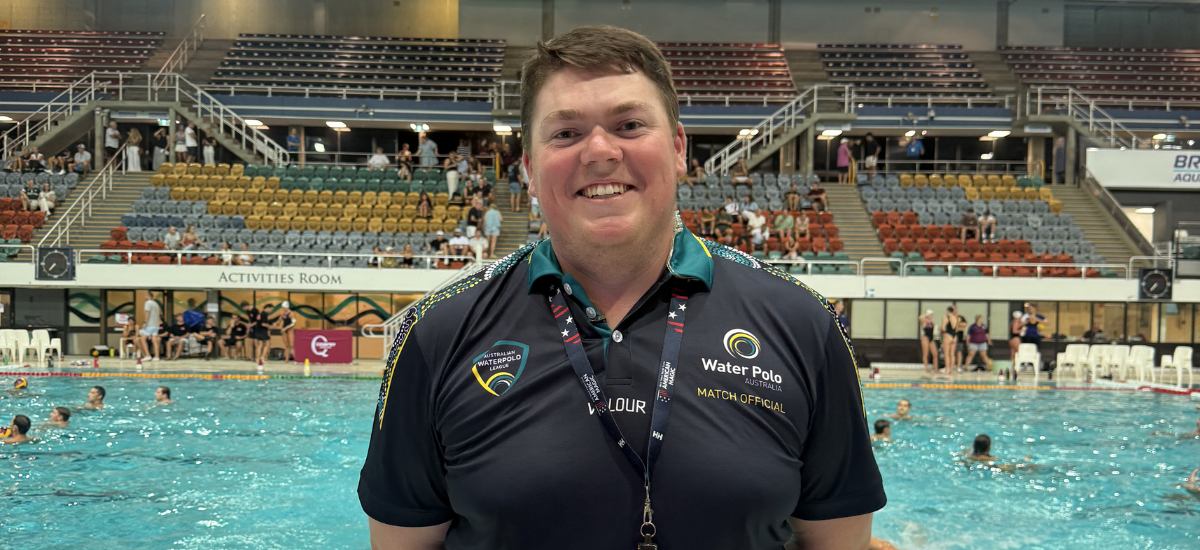
For Jacob Sharkey, picking up the whistle was never about stepping away from the game – it was about giving back to it.
Sharkey first began refereeing at this local club, Hutt Water Polo in New Zealand. Like many young players, he looked up to the senior members who volunteered their time to officiate and keep the competition running.
“It was just a natural progression to give back your time as those before you had. You idolise the senior platters who referee and want to be just like them,” Sharkey said.
Now in his first season as an Australian Waterpolo League (AWL) referee, Sharkey is experiencing the game at its highest domestic level and embracing the challenge that comes with it.
“AWL is very fast and high paced. I don’t think anything else compares to it. It’s been a big adjustment and learning curve, but I’ve thoroughly enjoyed the challenge.”
He credits the support of senior referees for helping him navigate the early stages of his AWL campaign.
“I’m super grateful for the guidance I’ve had. Hopefully one day I can return the favour to another referee,” he said.
Preparation is key, particularly in a competition where games can shift in an instant. Match day routines vary depending on travel and scheduling, but Sharkey ensures his focus sharpens well before the match starts.
“About 90 minutes out, it’s about arriving at the pool in ample time and speaking with your other referee about how you’re going to control the game and what the focus points are,” he said.
In tight contests, maintaining composure and consistency is critical, especially in the closing stages.
“Anything at the end of a close game can be challenging. You want to stay consistent with what you’ve called all game and not make a decision that determines the outcome.
“Anything that requires the much-dreaded red card. No one likes seeing red. Most of the time, the player, coach or spectator hasn’t left you with many other options. It’s a last resort,” he said.
One of Sharkey’s most memorable AWL fixtures so far came between the Griffith University Queensland Thunder and UNSW Wests – a high-stakes clash and a passionate home crowd.
“It was intense from the start. It definitely wasn’t my greatest performance on the whistle and the Queensland crowd let me know about it.”
Despite the pressure, the rewards of refereeing extend well beyond the pool deck. Opportunities to travel across New Zealand and Australia have been a highlight, but Sharkey measures success in a simpler way.
“One of the most rewarding things is when you leave a pool and no one knows who you are. I call that a good day’s refereeing. Everyone wants to know who you are when you do something wrong,” Sharkey said.
He hopes greater understanding can help strengthen the officiating community, particularly at a junior level.
“We don’t see the game from a fan’s video. We don’t get a rewind – we referee from a technical perspective in real time. Without referees, we don’t have games.”
For those considering stepping into officiating, Sharkey’s advice is straightforward.
“Just go for it. It’ll be one of the best things you can do. Your knowledge of the rules will take your game to the next level, and if you’re no longer playing but want to stay around this amazing sport, it’s a great way to stay involved,” he said.
Interested in picking up the whistle? Learn more about becoming a referee with Water Polo Australia here.